
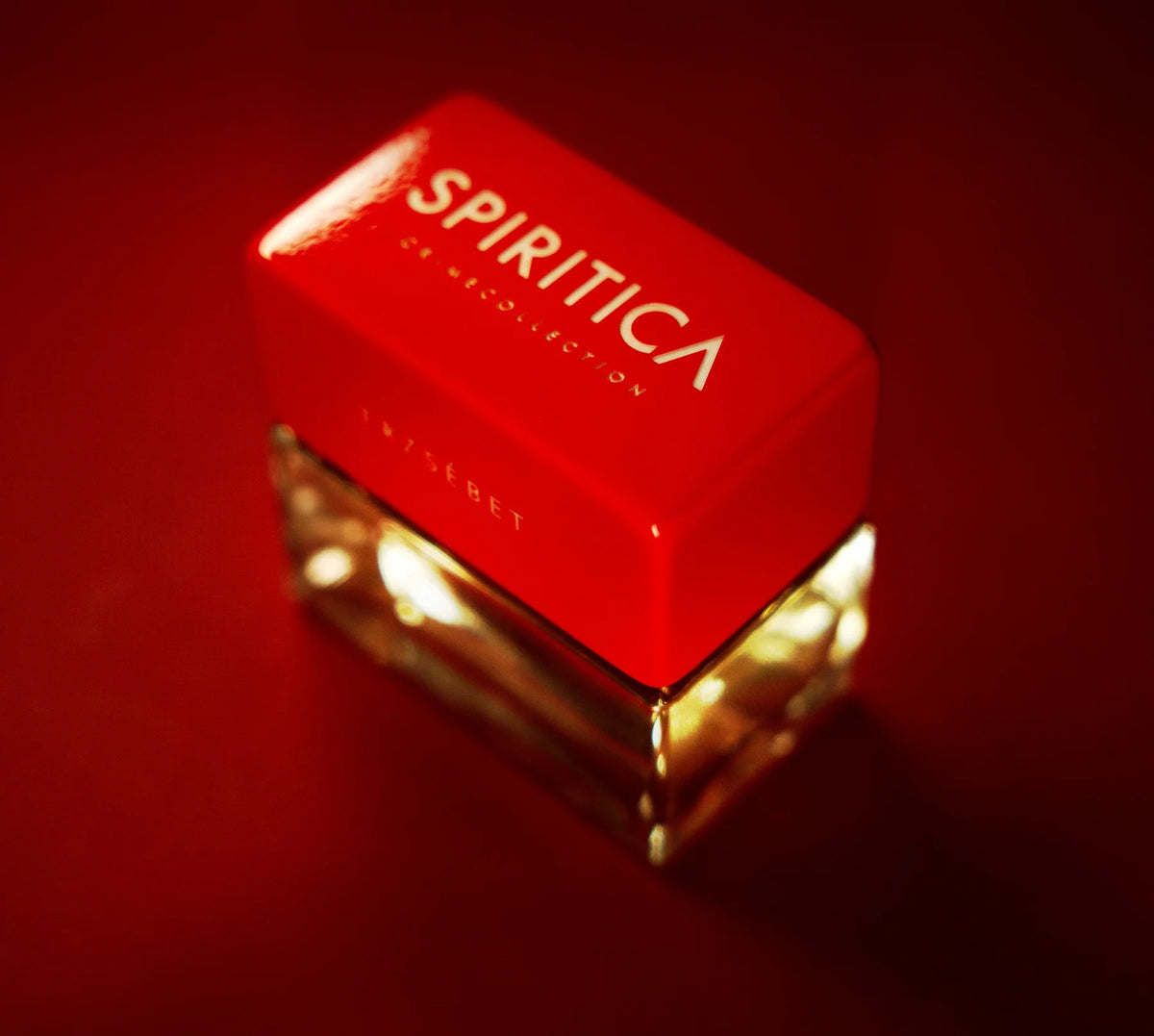
ERZSEBET
ERZSEBET
48.7250639° N | 17.7608361° E
Čachtice Castle, Slovakia
Olfactory family: White floral, aldehydic, carnal, metallic
Noses:
Miguel Matos
Daniele Muratori Caputo
Cold Aldehyde Head
Violet leaf
Blood
Black pomegranate
Heart
Blood
Tuberose Absolute
Jasmine Sambac
Iris
Vintage Soap Accord
Withered Rose
Background
Cold white musks
Sandalwood
Cashmeran
Wet stone
Ultra soft suede
Benzoin
Transparent labdanum
ETERNAL BEAUTY HAS THE FRAGRANCE OF BLOOD.
Kingdom of Hungary, 17th century.
Within the icy walls of Čachtice Castle, a woman enters dark legend.
Her name is Erzsébet Báthory .
Aristocratic, powerful, and feared, the Hungarian countess was accused of torturing and killing numerous young women. Her figure spans the centuries, shrouded in controversial testimonies, political intrigue, and increasingly terrifying tales.
According to legend, Erzsébet bathed in the blood of young virgins, convinced that this macabre ritual could eternally preserve her beauty.
An image destined to become immortal: the body immersed in blood, youth pursued through death, vanity transformed into obsession.
The historical story harbors numerous grey areas. The tale of the infamous bloodbaths spread long after the countess's death, fueling a myth in which historical facts, superstition, and collective imagination eventually overlapped.
It is precisely in this dimension suspended between reality and legend that ERZSÉBET is born , a new chapter in SPIRITICA's Crime Collection.
A unisex creation that explores the connection between beauty and cruelty, purity and contamination, sensuality and decadence.
At the heart of the composition, TUBEROSE dominates .
An opulent, narcotic, and deeply carnal white flower. Its sensuality is almost tangible: velvety petals, creamy nuances, and a floral intensity that evokes the skin, desire, and intimacy of the human body.
Its beauty has something unsettling, like a perfect face hiding a terrible secret.
The opening is icy, acidic, and sharp, like white nails in the darkness.
Cold aldehydes create an atmosphere of aristocratic cleanliness, interwoven with the green and metallic nuances of violet leaf. Black pomegranate releases a dark, penetrating juice, while a blood accord introduces a ferrous vibration, evoking freshly spilled blood.
The tension between beauty and anxiety immediately takes shape.
In the heart, tuberose absolute reaches its peak.
Sambac jasmine enhances its sensuality, while iris adds a powdery, refined, and almost ghostly dimension. The wilted rose suggests the slow passage of time, the fragility of petals, and the inevitable decline of beauty.
Among these flowers, a vintage soap accord emerges , evoking aristocratic beauty rituals: porcelain tubs, immaculate linens, perfumed skin, and obsessively repeated purification gestures.
Blood resurfaces in the floral heart, intertwining with tuberose and transforming its sensuality into an ambiguous, magnetic, and deeply disturbing presence.
In the base, cool white musks, sandalwood, and cashmeran create a soft, enveloping texture. Ultra-soft suede evokes the touch of skin, while wet stone evokes the humidity of the ancient castle walls.
Benzoin and transparent labdanum add depth and a resinous sensuality, leaving an elegant, mysterious, and lingering trail on the skin.
It's the silence after the ritual.
The tub is now empty.
The scent of flowers still hangs in the air.
CATHARSIS: TRANSCENDING TRAGEDY THROUGH ART
In ancient Greece, tragedy represented one of the most powerful tools through which human beings could confront suffering, fear, and the contradictions of their own nature.
Aristotle identified catharsis (κάθαρσις) as the process through which tragedy, arousing pity and fear, led the spectator to a profound transformation of his own emotional experience.
Through artistic representation, the most painful and disturbing aspects of existence could be contemplated, understood, and transcended.
Horror thus acquired a symbolic dimension, becoming an opportunity for reflection and awareness.
This is the philosophical principle that inspires SPIRITICA's Crime Collection.
Art possesses the extraordinary ability to transform humanity's darkest experiences into works capable of generating emotion, beauty, and meaning.
Crime becomes a subject of artistic investigation. Tragedy is explored through the senses, allowing us to explore the contradictions of human nature and confront what arouses fear, disturbance, and fascination.
In ERZSÉBET , this transformation occurs through the sense of smell.
Blood meets tuberose.
Violence confronts the delicacy of soap.
Death dialogues with the desire for eternal youth.
Each olfactory element harbors a contradiction and contributes to the construction of an experience in which pleasure and anxiety, attraction and repulsion coexist.
Perfume becomes a form of contemporary tragedy, told through an invisible, intimate, and deeply evocative material.
Beauty becomes the language through which to traverse the darkness.
ERZSÉBET represents the impossible desire to stop time, the obsession with perfection, and the fragility of a body destined to disappear.
An olfactory work that invites reflection on the more disturbing side of beauty and art's ability to transform even the most horrific imagery into profoundly emotional experiences.
In this encounter between aesthetics and tragedy lies the most authentic meaning of catharsis: the possibility of crossing the darkness and emerging from it transformed.
ERZSEBET - THE BEAUTY THAT REFUSES TO DIE.
As white as soap.
As carnal as tuberose.
As cold as stone.
As red as blood.
SPIRITICA - PARANORMAL LUXURY.